

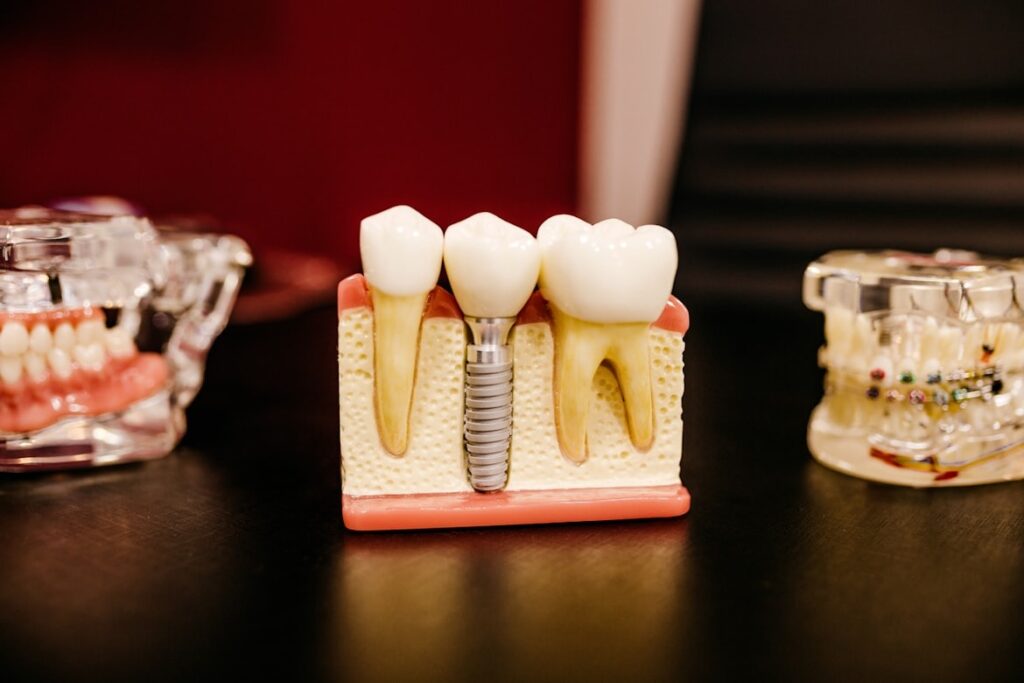
All-on-4 is a fixed full-arch tooth replacement approach in which four dental implants support a bridge for the upper or lower jaw.
Two implants are generally placed toward the front, and two posterior implants are tilted to make efficient use of available bone and avoid important anatomical structures. In suitable cases, a fixed provisional bridge can be attached on the day of surgery, but same-day loading is not appropriate for everyone.
The approach can reduce the need for bone grafting in some patients, but it does not eliminate grafting in every case. Long-term success depends on careful case selection, control of gum disease and other risk factors, a cleanable bridge design, good home care, and ongoing professional maintenance.
Complications can still occur, but the approach is well established rather than experimental.
How the All-on-4 process works
Treatment starts with a thorough assessment, scans, and planning.
On the day of surgery, four implants are usually placed in the jaw, two near the front and two angled towards the back to make use of available bone. If the implants achieve sufficient primary stability and the other clinical criteria are met, a fixed provisional bridge may be fitted on the day of surgery or soon afterward.
The provisional bridge is not automatically the final set of teeth. The implants need time to integrate with the jawbone, and the soft tissues need time to settle before the definitive bridge is fitted at the appropriate stage.
Your dentist will outline eating stages, from soft foods early on to a normal diet after healing. For day-to-day care, Health Direct suggests brushing twice daily, cleaning between teeth and implants, and attending regular check-ups.
Typical treatment stages
| Stage | What usually happens |
| Assessment and planning | Clinical examination, imaging, medical and dental history, gum and bite assessment, and prosthetic planning. |
| Surgery | Extractions if required, implant placement, and any additional procedures that are clinically necessary. |
| Provisional teeth | A fixed temporary bridge may be fitted promptly when immediate-loading criteria are met. |
| Healing | The implants integrate with bone while swelling settles and the bite, hygiene and bridge are reviewed. |
| Definitive bridge and maintenance | The final restoration is fitted when appropriate, followed by ongoing professional reviews and home care. |
Who is a good candidate?
All-on-4 suits adults who have lost most or all teeth in an arch, have dentures they cannot tolerate, or have multiple teeth with a poor long-term prognosis. Healthy, maintainable natural teeth should not be removed simply to make full-arch treatment more convenient.
Adequate bone volume helps, though the protocol often avoids grafting. Certain factors raise risk and must be managed. These include a history of severe gum disease, poor plaque control, smoking, and uncontrolled diabetes. Regular maintenance visits and home care are not optional. They are central to long-term success.
Active gum disease should be treated and brought under control before definitive implant therapy. A history of periodontitis does not automatically rule out implants, but it can increase long-term peri-implant disease risk and may justify closer maintenance.
A note on smoking: research consistently links tobacco use with higher implant failure and peri-implant disease. Meta-analyses report increased failure risk in smokers, and dose matters, with heavier smoking associated with worse outcomes. Quitting before and after surgery can improve prospects and should be discussed with your clinician.
What results can you expect?
Patients often report a stable bite, better speech than with removable dentures, and easier social eating. Evidence shows encouraging 5 to 10-year results, yet complications can include fracture or wear of the bridge, screw loosening, or biological issues like peri-implant mucositis and peri-implantitis. Early detection and professional care limit progression and help preserve implants for the long haul.
Implant survival is not the same as being maintenance-free. A well-integrated implant can remain stable while bridge teeth, screws or restorative materials wear, loosen, fracture or eventually need repair or replacement.
What does recovery usually involve?
Swelling, bruising, tenderness and minor bleeding can occur after implant surgery. The first few days are usually the most restrictive, although recovery varies with the number of extractions, the extent of surgery, your general health and the type of work you do. Follow the post-operative instructions from your treating team rather than a generic online timetable.
A softer diet is commonly recommended while the surgical sites heal and while an immediately loaded provisional bridge is being protected from excessive force. Contact your dental team promptly if pain or swelling is worsening rather than improving, or if you develop persistent bleeding, discharge, altered sensation, fever, movement in the bridge or a sudden change in your bite.
Costs and how patients pay for treatment
All-on-4 is a significant investment. In Australia, Medicare generally does not cover implant treatment in private practice. Some private health funds may contribute to parts of the treatment plan such as imaging or the prosthetic components, depending on your extras cover.
An exception applies for eligible veterans under the Department of Veterans’ Affairs, where limited implant entitlements exist for specific clinical scenarios. Always seek a written plan and itemised quote so you can check your cover before committing.
When comparing quotes, check whether they include imaging, extractions, sedation or anaesthesia, grafting if required, the provisional bridge, the definitive bridge, laboratory work, reviews and repairs during healing. Private-health benefits depend on the individual policy, waiting periods, annual limits and dental item numbers, so confirm benefits directly with your fund.
What to ask at your consultation
- Am I suitable for immediate loading? Not everyone can receive a fixed provisional bridge on the day. Bone quality, bite forces, and medical history guide that call. Evidence supports high survival when case selection is sound.
- Can any of my remaining teeth be predictably kept? Full-arch treatment should follow a diagnosis and prognosis for the existing teeth, rather than replacing salvageable teeth without a clear clinical reason.
- What materials will you use? Implants are typically titanium. Final bridges may be zirconia, titanium-acrylic hybrids, or other combinations. Your clinician should explain the trade-offs around strength, repairability, and aesthetics with real-world examples.
- How will you maintain my bridge and implants? Ask about specific tools, recall intervals, and who will see you for maintenance. Consistent professional care reduces the risk of peri-implantitis.
- What are the risks in my case? A frank discussion about gum disease history, smoking status, diabetes control, and clenching or grinding helps you understand your personal risk profile.
- What is included in the fee? Confirm whether imaging, extractions, sedation, provisional teeth, the definitive bridge, maintenance and repairs are included or billed separately.
For a longer checklist, check out these questions to ask before getting full dental implants.
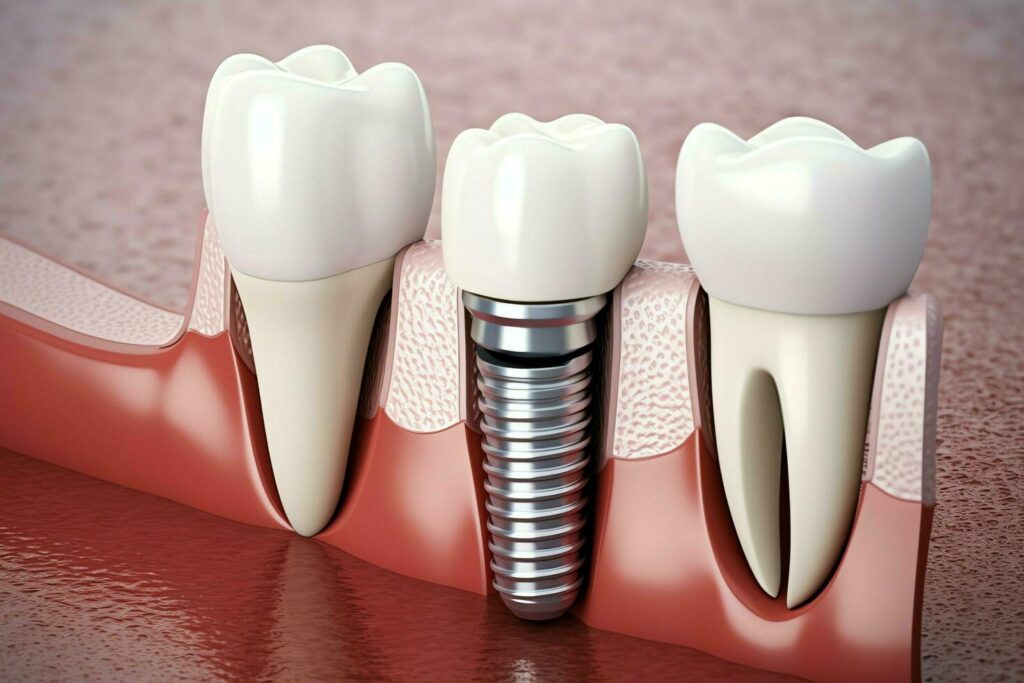
Common myths cleared up
“All-on-4 never needs cleaning.”
False. Biofilm still forms on prosthetic teeth and around implants, and neglected hygiene can lead to inflammation and bone loss.
“Grafting is always avoided.”
Not always. The technique reduces grafting for many, but some patients still benefit from additional procedures to achieve a stable result.
“Once integrated, implants cannot fail.”
Late complications happen, especially without maintenance or when risk factors persist. Early management keeps small problems small.
“All-on-4 and four-implant full-arch treatment always mean exactly the same thing.” Not necessarily. All-on-4® is the name of Nobel Biocare’s established treatment concept. Similar four-implant full-arch approaches may be described with related terms, but implant systems, loading protocols and prosthetic designs can differ. Ask what system and protocol your clinician is proposing.
Choosing a provider
Look for a clinician with solid experience in full-arch implant rehabilitation, access to 3D planning, and a maintenance pathway that is realistic for you. If you split your time between cities, plan follow-up accordingly.
Ask who will place the implants, who will design and fit the bridge, where the laboratory work is completed, and who manages complications or repairs if they arise.
Location can shape practical choices too. Reliable follow-up is a better predictor of long-term comfort than chasing the lowest initial quote.
If you are comparing full-arch treatment with preserving suitable teeth through individual or multiple implants, take a look at the differences between single implants and All-on-4.
Frequently asked questions
How long do All-on-4 dental implants last?
There is no single guaranteed lifespan. Long-term studies report high implant survival, but the bridge, teeth, screws and other prosthetic parts may need maintenance, repair or replacement over time. Smoking, gum-disease history, plaque control, bite forces and attendance at maintenance visits can all affect outcomes.
Can All-on-4 be done without bone grafting?
Often, but not always. Tilting the posterior implants can help clinicians use available bone and avoid some anatomical limitations, which is one reason grafting may be reduced. Severe bone loss, defects, infection or the planned implant positions can still make grafting or a different treatment approach appropriate.
Are All-on-4 teeth fitted on the same day?
Some patients can receive a fixed provisional bridge on the day of surgery or shortly afterward. Immediate loading depends on adequate implant stability and other clinical factors. If those criteria are not met, the safer plan may be to allow healing before attaching a fixed bridge.
How do you clean under an All-on-4 bridge?
Cleaning must reach the gumline and the space beneath the bridge, not just the visible tooth surfaces. Depending on the design, your dental team may recommend a toothbrush plus interdental brushes, specialised floss, a water flosser or other aids. The technique should be demonstrated for your particular bridge.
What are the alternatives to All-on-4?
Alternatives can include retaining and restoring suitable natural teeth, individual or multiple implants, implant-supported overdentures, conventional removable dentures, or full-arch implant designs using a different number or position of implants. The right option depends on the prognosis of your teeth, bone, medical factors, hygiene, budget and preferences.
Bottom line
All-on-4 offers a fixed, natural-looking solution for people missing most or all teeth in an arch. If you are weighing your options, start with a comprehensive consultation and a written plan. Then assess not only price, but the support you will receive for the years ahead.
Considering All-on-4 dental implants? Book a consultation to assess your teeth, bone, gum health and treatment options, and get a personalised plan based on your needs.